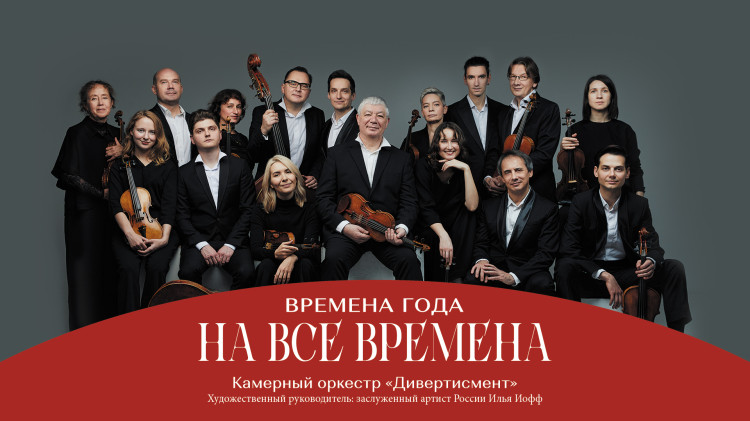
On November 13, one of the leading ensembles of the leading ensembles of "Petersburg-Concert" — the Divertissement Chamber Orchestra, together with its artistic director and soloist, Honoured Artist of Russia Ilya Ioff — invites you to the Fabergé Museum for one of the orchestra's most famous and beloved programmes: The Seasons for All Times. The orchestra's repertoire includes no fewer than twelve different works bearing this title, from Vivaldi's immortal cycle to pieces by contemporary minimalist composers. As a rule, the musicians build a single programme around the changing of the seasons.
The programme on November 13 is dedicated to autumn and winter. That evening, audiences will hear: "Winter" by Antonio Vivaldi; "October. Autumn Song" and "December. Christmas" by Pyotr Ilyich Tchaikovsky from his cycle The Seasons; "Winter" by Max Richter from Vivaldi's Four Seasons. Recomposed; "Autumn" by Sergei Akhunov; "Autumn" and "Winter" from The Four Seasons of Buenos Aires by Astor Piazzolla; and "Autumn" and "Winter" by Osvaldo Requena.
Antonio Vivaldi's ingenious and sumptuously Baroque Four Seasons brings together four concertos for violin and strings. In 1725, one of Vivaldi's most celebrated collections was published — Opus 8, consisting of twelve violin concertos and bearing the subtitle The Contest Between Harmony and Invention. The first four concertos of this opus were given the titles "Spring," "Summer," "Autumn," and "Winter." Each is preceded by a short sonnet, presumably written by Vivaldi himself. In modern performance practice, the concertos are often grouped together as The Four Seasons — a title that does not appear in the original.
Tchaikovsky's The Seasons was composed in 1875–1876 on a commission from the well-known St. Petersburg publisher N. M. Bernard, who approached the composer with the idea of writing a cycle of piano pieces for the journal Nuvellist — pieces that would be published monthly and thus form a complete cycle of the year. Strictly speaking, the title The Seasons is not entirely accurate in this case, since Tchaikovsky, with his characteristic psychological depth, depicted not so much the yearly cycle of nature as the ever-changing, multifaceted feelings of the human soul. Tchaikovsky's Seasons became extraordinarily popular not only in their original piano form but also in instrumental and orchestral arrangements.
Astor Piazzolla was a celebrated Argentine musician and composer of Italian descent. The Four Seasons of Buenos Aires consists of four tangos: "Autumn," "Winter," "Spring," and "Summer." This music has long since found its way to audiences here and become one of those hits that people come to hear for the name alone. Its distinctive rhythms and harmonies reflect the composer's sense of the passage of time. Piazzolla boldly combines Latin American and jazz motifs with the classical tradition.
Osvaldo Requena's The Seasons is a colourful work by an Argentine composer. It transports the listener into a world where the characteristic rhythms of tango blend with depth of feeling and a boundless sense of love.
The Seasons by the contemporary Moscow composer Sergei Akhunov is perhaps the newest cycle on this theme — it was written in 2014. The work was inspired by Kim Ki-duk's film Spring, Summer, Fall, Winter… and Spring — which is why the cycle has five movements: five seasons.
The contemporary British composer Max Richter, known for his film scores (including collaborations with Martin Scorsese and Ridley Scott), presented his own version of The Four Seasons in 2012. Curiously, Vivaldi's musical material is preserved in it, yet it sounds entirely new — fused with the inflections of contemporary musical language. Who knows — perhaps the great representative of the Baroque would have written his masterpiece in precisely this way, if he were alive today.
Performers
Divertissement Chamber Orchestra
Artistic Director and Soloist — Honoured Artist of Russia Ilya Ioff
PROGRAMME:
- Max Richter — "Winter" from Vivaldi's Four Seasons. Recomposed;
- Osvaldo Requena — "Autumn" from The Seasons;
- Sergei Akhunov — "Autumn" from The Seasons;
- Astor Piazzolla — "Autumn" from The Four Seasons of Buenos Aires;
- Pyotr Ilyich Tchaikovsky — "October. Autumn Song" from The Seasons;
- Osvaldo Requena — "Winter" from The Seasons;
- Astor Piazzolla — "Winter" from The Four Seasons;
- Pyotr Ilyich Tchaikovsky — "December. Christmas" from The Seasons;
- Antonio Vivaldi — "Winter" from The Four Seasons.
Running time: 1 hour 10 minutes, no intermission.
Venue: Ground floor of the exhibition space, Fabergé Museum